Bible Topics 📚
2 Esdras 7 (also known as 4 Ezra 7) presents a profound vision of judgment that’s rarely spoken about or mentioned. However, it’s one of the most powerful and sobering chapters in the apocalyptic writings of the Bible’s Deuterocanonical books. Ezra is shown a narrow path between fire and water, symbolizing the dangerous and difficult journey toward eternal life. Only one can walk it at a time, stressing the personal responsibility and effort required for salvation. This imagery highlights that salvation is not easily attained, and those who walk it must be faithful, righteous, and enduring.
Ezra is then told that after death comes judgment. The souls of the righteous are kept in peace, joyfully awaiting their reward, while the wicked are tormented, fully aware that there is no hope for them. The chapter clearly illustrates the eternal separation between the just and the unjust, even before the final resurrection. The righteous will stand boldly before those who once afflicted them, confident in their standing before God.
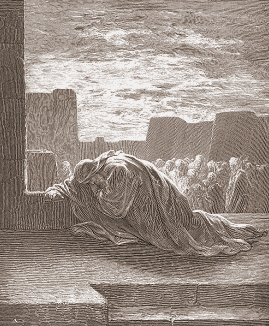
Ezra laments over the many who will be lost, asking why the punishment must be so severe. The angel Uriel responds that while God made the world for many, the world to come is for few, because many choose rebellion over obedience. Despite God’s commandments and countless chances to repent, people continually reject His ways. This underscores the righteousness of God’s judgment and the urgency of repentance.
God is revealed as both merciful and just. He gave clear laws, sent prophets, and offered life, but mankind chose sin. The angel reminds Ezra that every soul had a chance and was fully informed of the consequences of their choices. Therefore, the condemnation of the wicked is not cruelty, but justice.
Finally, the chapter speaks of the coming resurrection. The righteous will rise to receive eternal joy and rest, while the wicked face everlasting torment. This is the moment of final justice, where God rewards every man according to his works. Those delivered from evil will witness God’s wonders.
In summary, 2 Esdras 7 is a powerful revelation of eternal judgment, divine justice, and the narrow way of salvation. It calls readers to fear the Lord, live righteously, and prepare now, for the day of judgment is near, and only those who persevere in faith will inherit the world to come.
7 When I finished speaking these words, the angel who had been sent to me on the previous nights was sent to me again. 2 He said to me, “Rise, Ezra, and hear the words I have come to speak to you.”
3 I said, “Speak, my Lord.”
He said to me: “A certain sea is set in a spacious place so that it can be deep and vast, 4 but its entrance is set in a narrow place, like a river. 5 If anyone wants to go to the sea to see it or to rule over it, how can he come into the broad place unless he passes through the narrow? 6 Another instance: A city is built and positioned on a broad plain, full of all good things. 7 Its entrance, however, is narrow and located on a precipice so that there is fire on the right and deep water on the left. 8 There is a single path located between them, between the fire and the water, and the path has only room for human footprints. 9 If that city is given to someone as an inheritance, if the heir doesn’t pass through the danger, how will the heir receive the inheritance?”
10 I said, “Indeed, Lord.”
He said to me: “So also is Israel’s portion. I indeed made the world on account of them. 11 When Adam transgressed my ordinances, what had been made was judged, 12 and the entrances of this world were made narrow, sorrowful, and troublesome. They are few and bad, full of dangers and involving people in great hardships. 13 The entrances of the greater world, however, are spacious and secure, and they generate the fruit of immortality. 14 If those who live don’t enter these narrow and empty places, they can’t receive the things that are in store. 15 Therefore, why are you disturbed, being corruptible, and why are you upset, being mortal? 16 Why haven’t you focused your mind on what is still to come, rather than on what is present?”
17 I answered: “Supreme Lord, you ordained in your Law that the just will inherit these things, but the impious will perish. 18 The just then can tolerate the narrow, hoping for the spacious, but those who have acted impiously endure the narrow and won’t see the spacious.”
19 He said to me: “You aren’t a higher judge than God, nor more intelligent than the Most High. 20 Better that many of those now alive should perish than that the Law of God, which is laid out before them, be disregarded. 21 God commanded those who come into the world, after they came, what they needed to do to live, and what laws they should observe to avoid punishment. 22 But they weren’t persuaded and opposed him. They filled their heads with worthless thoughts, 23 and they invented excuses for their sins. They emphatically denied that the Most High exists, and they didn’t learn his ways. 24 They despised his Law and rejected his covenants. They weren’t faithful to his statutes, and didn’t perform the works he prescribed. 25 Therefore, Ezra, empty things are for the empty and full things for the full.
26 “Look! The time is coming when the signs appear that I told you about in advance, and the city will appear, appearing as a bride, and the land that is now hidden will be openly displayed. 27 Everyone who is rescued from the evils foretold will see my wonders. 28 My Son the anointed one[a] will be revealed along with those who are with him, and those who remain will rejoice for four hundred years.
29 “After these years, my Son the anointed one and all who have human breath will die. 30 The world will be turned back to primeval silence for seven days, as in the earliest beginnings so that no one is left alive. 31 After seven days, the world that isn’t yet awake will be roused, and the corrupt world will die. 32 The earth will give back those who sleep, and the dust will give back in silence those who dwell in it, and the resting places will give back the souls that have been entrusted to them. 33 The Most High will be revealed on the throne of judgment, and mercy will pass away. Patience will be withdrawn, 34 and only judgment will remain. Truth will arise, faith will recover strength, 35 and works will have their consequences. Reward will come about, righteous deeds will awake, and unrighteous deeds won’t sleep.
36 “The lake[b] of torment will appear, and across from it will be the place of rest. Hell’s[c] furnace will be displayed and across from it the delightful paradise. 37 Then the Most High will speak to the nations that have been raised: ‘Look and understand whom it is you have denied, whom you haven’t served, and whose ordinances you have despised. 38 Look to one side and the other: Here is delight and rest, and over there are fire and torments.’ He will say these things to them on the Judgment Day, 39 a day that has no sun or moon or stars, 40 no cloud or thunder or lightning, no wind or water or air, no darkness or evening or morning, 41 no summer or spring or heat, no winter or frost or cold, no hail or rain or dew, 42 no noon or night or early dawn, no shining or brightness or light, but only the splendor of the light of the Most High. All will then begin to see what things are in store for them. 43 It will take a period of about a week of years. 44 This is my judgment and the arrangements made for it. I have shown this to you alone.”
45 I replied: “I said before, Lord, and I say now: Privileged are those now living who observe what you have commanded. 46 But what of those who were the subject of my prayer? Who is there of all the living who hasn’t sinned, or who among those who have been born hasn’t transgressed your covenant? 47 Now I see that the world to come will bring delight to few but torment to many. 48 The inclination to do evil[d] grew in us. It alienated us and led us into corruption and the paths that lead to death. It showed us the way to damnation and removed us far from life—and this happened not to a few people but to nearly all who were created.”
49 He replied to me: “Listen to me, and I will instruct you and will advise you yet again. 50 Because of this the Most High made not one world but two. 51 Regarding what you said about the just being not many but few and the wicked being numerous, think about this: 52 If you have very few choice stones, will you add lead and clay to their number?”[e]
53 I said, “Lord, who would do such a thing?”
54 He said to me, “Not only this, but ask the earth and it will inform you; flatter it and it will tell you. 55 Say to it: You create gold, silver, bronze, iron, and also lead and clay. 56 But silver is more numerous than gold, and bronze than silver, and iron than bronze, lead than iron, and clay than lead. 57 Decide yourself then which things are precious and desirable, what is abundant or what is rare.”
58 I said, “Supreme Lord, that which is abundant is cheaper, because what is more rare is valuable.”
59 He replied to me: “Reflect on what you have thought. One who has what is scarce rejoices more than one who has what is abundant. 60 So also will be the judgment[f] I have promised. I will rejoice over the few who will be saved, because they are the ones who made my honor to prevail now and through whom my reputation is celebrated. 61 I will have no regrets over the multitude who perish, for they are even now like vapor, the equivalent of flame or smoke; they burn and flare up and are quenched.”
62 I replied: “Earth, what have you brought to birth? If consciousness is made of dust like other creatures, 63 it would have been better that the dust itself had never been born, so that consciousness shouldn’t be made from it. 64 But now consciousness grows with us, and due to this we are tortured, because we perish and are aware of the fact. 65 Let the human race lament and let the wild beasts rejoice. Let all people who are born lament, but let four-footed animals and flocks be happy! 66 It is much better for them than for us. They don’t expect judgment. They don’t know about either the torments or the deliverance that you promise after death. 67 But what does it profit us that we will be preserved, only to be tortured with torments? 68 All who are born are mixed up with violations, full of sins, and weighed down with crimes. 69 If we were not to come into judgment after death, it would perhaps have been better for us.”
70 He replied to me: “When the Most High made the world and Adam and all who are descended from him, he first prepared the judgment and the things that pertain to the judgment. 71 Now understand on the basis of your own words—because you said, ‘Consciousness grows with us.’ 72 Those who sojourn on earth will be tormented precisely because, although they were aware, they committed violations. Although they received the commandments, they didn’t keep them. When they did follow the Law, they falsified its contents. 73 What will they have to say in the judgment? How will they respond in the last times? 74 How long a time the Most High has put up with those who inhabit the world! But this wasn’t for their sakes; rather for the sake of the schedule that he has established for the unfolding of the times.”
75 I replied: “If I have found favor with you, Lord, show this also to your servant: After death, as soon as each person gives up his or her soul, will we be kept asleep until the time comes for you to begin to renew creation, or will we be tormented right away?”
76 He replied to me: “I will show you this too. But don’t associate yourself with those who have shown contempt, and don’t count yourself among those who are tormented. 77 You have a treasure of works stored up with the Most High, but it won’t be shown to you until the last times.
78 “Now a word about death: When the final sentence goes forth from the Most High that a person should die, when the spirit recedes from the body so that it may be sent again to him who gave it, the first thing is to stand in awe before the glory of the Most High. 79 If the spirit belonged to one of those who showed contempt and didn’t keep the Most High’s way, if it was one of those who despised his Law and who hates those who fear God, 80 these spirits don’t go into their dwellings but will immediately wander about in torments. They will constantly grieve and be sorrowful for seven reasons:[g]
- 81 The first reason—because they despised the Law of the Most High.
- 82 The second reason—because they can’t now effectively change their hearts and lives so that they might live.
- 83 The third reason—because they will see the reward laid up for those who have believed the Most High’s testimonies.
- 84 The fourth reason—because they will consider the torment laid up for themselves in the last days.
- 85 The fifth reason—because they will see the dwelling places of others, guarded by angels in great silence.
- 86 The sixth reason—because they see the torment coming upon them from now on.[h]
- 87 The seventh reason, which is greater than all the previously mentioned reasons—because they will melt away in confusion and be consumed in disgrace.[i]
“They will wither in fear when they see the glory of the Most High, before whom they sinned when they were alive and before whom they are to be judged in the last times.
88 “The arrangement for those who kept God’s ways is this when they begin to be separated from the corruptible body.[j] 89 In the time of their exile here they labored hard to serve the Most High. Every hour they endured danger so that they might keep the Law of the lawgiver perfectly. 90 Therefore, this is the word about them: 91 First, they will see with great joy the glory of him who receives them. They will have rest on account of seven orders:
- 92 The first order—because they have struggled hard to overcome the evil thought fashioned within them so that it wouldn’t lead them astray from life to death.
- 93 The second order—because they see the panic in which the souls of the wicked wander and the punishment that awaits them.
- 94 The third order—seeing the testimony that their maker has testified on their behalf, because when they were alive, they kept the Law that was given through faith.
- 95 The fourth order—understanding the peaceful rest that they now enjoy, gathered in their resting chambers, guarded by angels in deep silence, and understanding the glory that awaits them in their last days.
- 96 The fifth order—rejoicing at how they have now escaped the corruptible and how they will have a future inheritance; moreover, seeing the narrow space, full of labor, from which they have been freed, and the spacious place they are about to receive and enjoy, now that they are immortal.
- 97 The sixth order—when they are shown how their face begins to shine like the sun and how they begin to be like the stars, as beings of incorruptible light.
- 98 The seventh order, which is greater than all those mentioned—because they will rejoice with confidence and will trust without being disappointed and will rejoice without fear; for they hasten to see the face of him whom they served when they were alive and from whom they are about to receive a reward now that they are glorified.
99 “This is the order of the souls of the just, as is announced immediately, and those previously mentioned are the ways of torment that those who paid no heed will suffer.”
100 I answered: “Will time, therefore, be given to souls after they are separated from the bodies to see what you told me?”
101 He said to me: “They will be free for seven days so that they may see in those seven days the things[k] that have been foretold. After this, they will be gathered in their dwelling places.”
102 I answered: “If you look on me with favor, show your servant further whether on the Judgment Day the just will be able to seek mercy for the wicked or intercede for them with the Most High. 103 Will parents be allowed to intercede[l] for children, children for parents, siblings for each other, relatives for those close to them, faithful ones for those most dear to them?”
104 He replied to me: “Because I do indeed favor you, I will also show you this. The Judgment Day is decisive.[m] It reveals the seal of truth to all. Even in the here and now a parent doesn’t send a child, or a child the parent, or a master his servant, or a faithful friend a dear confidant, so that the one should understand or sleep or eat or be taken care of in the other person’s place. 105 Just so, no one will ever intercede for another; everyone will then bear his or her own deeds of justice or injustice.”
106 I answered: “How then do we find that Abraham first interceded for the people of Sodom; and Moses for our ancestors who sinned in the desert; 107 and Joshua, who came after him, for Israel, in the days of Achan; 108 and Samuel in the days of Saul;[n] and David for the plague;[o] and Solomon for those in the sanctuary; 109 and Elijah for those who received the rain, and for a dead person that he might live; 110 and Hezekiah for the people in the days of Sennacherib, and many for many people? 111 If, therefore, the just prayed for the wicked when corruption had increased and injustice had multiplied, why won’t it be the same then?”
112 He answered me: “The present world isn’t the end. Glory does not[p] continuously remain in it, and so those who were able prayed for the weak. 113 But the Judgment Day will be the end of this time and the beginning of the future, endless time in which decay is no more, 114 indulgence is undone, unbelief is cut off, but justice is fully grown, and truth arisen. 115 Therefore, no one will then be able to have mercy on someone who has been condemned in the judgment, nor to overwhelm one who has conquered.”
116 I answered: “This is my first and last word: It would have been better if the earth hadn’t brought forth Adam, or when it had brought him forth, that it had forced him not to sin. 117 What does it benefit everyone to live in sadness during the present time, and when dead to expect punishment? 118 Adam, what have you done?! If you sinned, the downfall wasn’t yours alone but also ours who are descended from you. 119 What benefit is it to us that we are promised an immortal time, but we have done works that bring death? 120 What good is it to us that everlasting hope has been predicted for us, but we have utterly failed? 121 What good is it that safe and healthy dwelling places are reserved, but we have behaved badly? 122 What good is it that the glory of the Most High will protect those who have conducted themselves decently, but we have conducted ourselves indecently? 123 What good is it that paradise will be revealed, whose fruit remains uncorrupted, in which there is plenty and healing, 124 but we won’t enter it, for we have visited unseemly places? 125 What good is it that the faces of those who practiced abstinence will shine brighter than stars when our faces are blacker than darkness? 126 While we were alive and doing evil, we didn’t think about what we would suffer after death.”
127 He answered: “These are the rules for the contest in which everyone born on earth takes part: 128 Those who are defeated will suffer what you said, but those who conquer will receive what I say. 129 This is the path that Moses declared when he was alive, speaking to the people, Choose life for yourself… so that you may live.[q] 130 But they didn’t believe him or the prophets who came after him. They didn’t even believe me when I spoke to them. 131 There won’t be sadness over their destruction, as there will be joy over those for whom salvation is sure.”
132 I answered: “I know, Lord, that the Most High is now called merciful, since he has mercy on those who haven’t yet come into the world. He is called 133 gracious, since he has mercy on those who convert to his Law, 134 and patient, because he shows patience to those who have sinned, since they are his own creation. 135 I know that he is called generous, because he wants to give gifts rather than demand them, 136 and very merciful, because he multiplies mercies more and more to those now alive and those who went before and those who are to come in the future. 137 If, indeed, he hadn’t multiplied them, the world with those who live in it would not now exist. 138 He is called[r] giver, because if he didn’t give out of his own goodness some relief from their sins to people who committed sins, not one ten-thousandth part of humanity could live. 139 He is called judge, because unless he forgave those created by his word and wiped out the multitude of their offenses, 140 perhaps only a very few would be left from the innumerable multitude.”
🌿 Devotional: The Narrow Way and the Judgment to Come
Based on 2 Esdras 7 (KJV Apocrypha)
Opening Scripture
“There is also another thing: A city is builded, and set upon a broad field, and is full of all good things: The entrance thereof is narrow, and is set in a dangerous place to fall, like as if there were a fire on the right hand, and on the left a deep water.” — 2 Esdras 7:6–7
Meditation: The Path Few Find
The prophet Ezra was given a vision so weighty, it pierced through time and eternity. He saw the path to salvation—a narrow, perilous way bordered by fire and deep waters. This powerful image reminds us that the journey to eternal life is not broad, nor easy, and each person must walk it alone. The Lord has not called us to comfort, but to endurance and righteousness. Many seek the wide road of pleasure, ease, or delay. But 2 Esdras 7 declares that salvation is personal, and only those who remain steadfast shall see the glorious city filled with all good things. Just as Jesus said, “Strait is the gate, and narrow is the way, which leadeth unto life, and few there be that find it.” (Matthew 7:14)
Judgment After Death
The Lord reveals to Ezra that after death comes the judgment. There is no purgatory, no pause in the plan—only two destinations. The righteous rest in peace, awaiting their final reward with joy. But the wicked, knowing what awaits, are already tormented, grieving the chances they rejected. “Now this is the order of those who have kept the ways of the Most High… they shall rejoice with confidence.” (2 Esdras 7:88) Even before the resurrection, the souls of men are sorted. God’s justice is immediate, exact, and eternal.
A Cry for Mercy
Ezra, heartbroken by the fate of the lost, cries out for mercy. He pleads, “Why so many perish, Lord?” But the angel answers, “The world is made for many, but the world to come for few.” Why? Because men choose darkness over light, sin over truth. They hear God’s commandments and cast them behind their backs. “For God hath given straight commandment… what they should do to live… Nevertheless they were not obedient unto him.” (2 Esdras 7:21–22) Though mercy is freely offered, judgment is unavoidable for the rebellious. God is not to blame—men have rejected His mercy.
The Resurrection and Everlasting Life
There shall be a resurrection. The righteous will inherit eternal joy, dwelling in the presence of the Most High forever. But the wicked shall face eternal fire and shame. The soul that lived for self will perish, and the one who feared the Lord will be crowned. “Whoso is delivered from the foresaid evils shall see my wonders.” (2 Esdras 7:27) “The day of judgment is the end of this time, and the beginning of the immortality for to come.” (2 Esdras 7:43) God’s justice is the beginning of forever. What we choose now determines what we receive then.
Personal Reflection & Application
Am I walking the narrow path daily, even when it is hard?
Have I rejected or ignored God’s Word in any area of my life?
Do I live with the fear of the Lord, knowing judgment follows death?
Am I pleading for souls like Ezra, interceding for those who do not know?
Let us take these questions to heart and walk soberly, knowing that we are one breath away from eternity!
Closing Prayer
Heavenly Father, Your Word is holy, righteous, and true. I thank You for the warnings You give and the mercy You extend. Help me walk the narrow path with fear and trembling, and not stray to the left or to the right. Give me a heart that weeps for the lost and lives ready for judgment. May I be found faithful in that great day. In Jesus’ name I pray, Amen.
Suggested Reading
Matthew 7:13–14
Ecclesiastes 12:13–14
Revelation 20:11–15
2 Corinthians 5:10
Luke 13:24